Website backups are among the most essential safeguards for any WordPress site. Updates don’t always go as planned, plugins can clash, and unexpected issues like security breaches or server downtime can occur at any time.
In those situations, having a recent backup can mean restoring your site in minutes instead of rebuilding everything from the ground up.
Traditionally, WordPress backup plugins have relied on third-party cloud services such as Google Drive or Dropbox to store off-site copies. While effective, this setup requires connecting to external accounts and managing multiple platforms simultaneously.
Backup Migration plugin introduces a different approach. It is the first WordPress backup plugin to include its own built-in cloud storage solution, BackupBliss, available at no cost. Instead of relying entirely on external providers, users can store their backups in a secure environment created specifically for WordPress data.
Create Automatic Backups In Just A Few Clicks
Getting started with Backup Migration is quick and simple. After installing and activating the plugin from the official WordPress repository, you can begin creating backups right away using its pre-configured default settings. The interface is designed for ease of use, allowing you to generate a full backup with a single click.
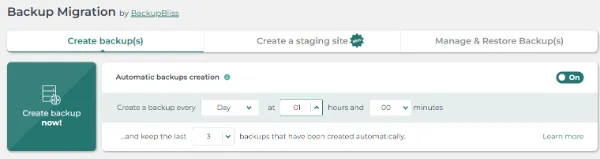
For ongoing protection, enabling scheduled backups is highly recommended. The plugin allows you to automate the process by setting up recurring backups that run quietly in the background.
Many users opt for weekly full-site backups by default, though the frequency can be adjusted based on how often the site content changes.
Once scheduling is enabled, backups are created automatically at the defined intervals. These files can then be sent to your chosen storage destination, ensuring your data is safely stored outside your hosting environment.
Connect To BackupBliss Cloud Storage
To use BackupBliss, you first need to create a free account (does not require a credit card!), which provides 1GB of storage. After signing up, you should generate an API key to securely link your cloud storage with the Backup Migration plugin.
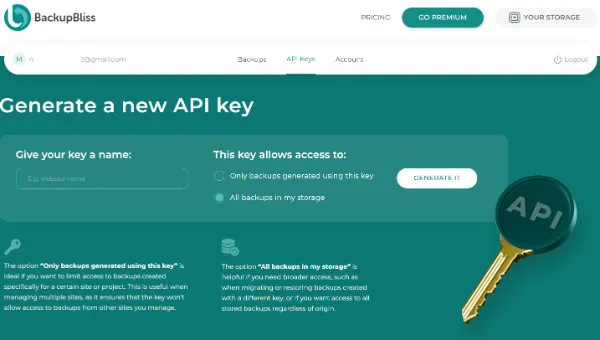
Within the plugin settings, go to the section labeled “Where shall the backup(s) be stored?”, select BackupBliss, and enter your API key to establish the connection.
From that moment on, backups will be automatically uploaded to your BackupBliss cloud space. This ensures your data remains safe and accessible, even if your website or hosting server encounters issues.
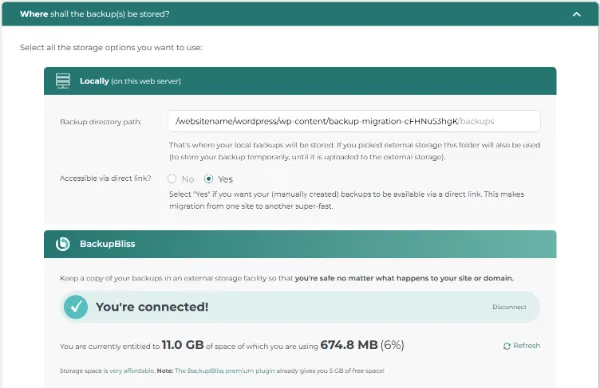
In case you want to store your backups in additional locations, you have several popular storage locations also available in the plugin: Google Drive, Dropbox, OneDrive, pCloud, FTP/SFTP, Amazon S3, or Wasabi. The plugin will keep automatically syncing to all that you connect.
Creating More Refined Backups
Although the Backup Migration plugin comes with optimized, pre-defined settings for backup creation, you can further optimize this for your own needs. Navigate to the plugin section What will be backed up?, where you can add your own inclusion and exclusion rules for files and folders included in the backup.
For example, if your site generates a lot of temporary or unwanted files of a specific type, you can exclude them here by extension name or a path location. In another example, smart exclusion rules enable you to skip unwanted website parts like post revisions.
On the other hand, some users prefer to have absolutely everything included in backups (cache, log, temporary, and other less desired files), and if you are one of them, you can ensure that all files, folders, and the database are selected without any exclusions.
Additional Automatic Backups
Aside from regular scheduled backups, which run on a specified time, you can also enable selective backups before automatic updates of plugins, themes, and WordPress core.
This feature is useful for all users who have everything in WordPress set for auto-updates. In case any update breaks something, you can use these backups to roll back and quickly prevent damage to your site.
Another available trigger here is the secret URL that can be used to initiate the website backup – your security button, available to you wherever you are. Both of these features are included in the premium version of the plugin.
Restoring A Backup (From A Cloud)
After making sure that you have the Backup Migration plugin activated on the site and your preferred external storage connected, you can proceed with restoring the selected backup file. In the plugin section Manage & Restore Backup(s), there are multiple ways to complete the migration.
1. Cloud storage migration – You can migrate your site using a connected cloud storage provider. The plugin supports its own built-in cloud storage, BackupBliss, as well as external services like Google Drive or Dropbox. To use this method, connect the chosen storage on both the source and destination sites.
2. Super-quick migration – This option allows you to paste the direct link of the backup file from the source site and click Restore now. The backup link can be copied from the same plugin section by clicking the link icon next to the backup file.
3. Manual upload backup file – Alternatively, you can manually upload the backup file using the Upload backup files option. You can either select the file or use drag-and-drop. Once the upload is complete, click the Restore button next to the file to start the process.
After completing the restore process, your website will be fully migrated to the new location, including all content, settings, and structure. There is no need for any additional manual work like adjusting internal links of similar “search and replace” actions.